UV DTF Film Cost Explained: Virgin PET, Yield and Compliance
- Share
- publisher
- FCOLOR
- Issue Time
- Oct 26,2026
Summary
Why UV DTF Film costs more than cheap film: the three failure modes of low-cost film (poor adhesion, hard waste removal, adhesive that does not last) and why none are caught at printing, the two manufacturing choices behind the price gap (recycled material and batch-to-batch variation), what virgin PET and multi-point inspection buy you, the honest position on yield-rate and service-life claims, EU RoHS and REACH compliance scope, and the qualification documents available on request.
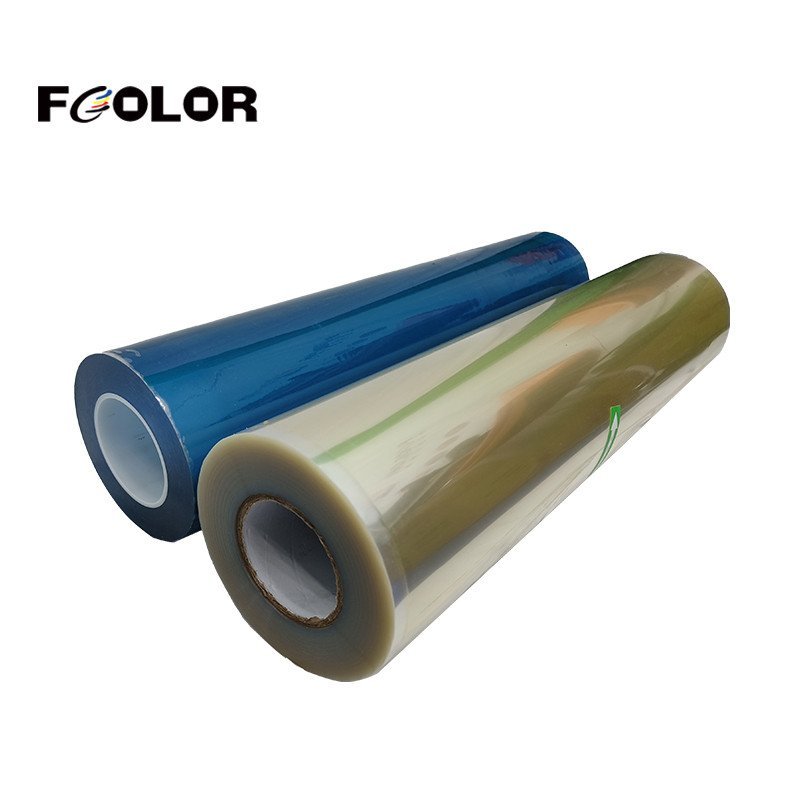
The first question most buyers ask about our UV DTF crystal label film is why it costs more than the film they are using now. It is a fair question, and the honest answer is not “because it is better.” It is: the cheap film is cheaper because of two specific choices made during manufacturing, and both of them cost you money later.
This article breaks down what those choices are, what they do to your production, and what our compliance position actually covers — including the part it does not.
What Goes Wrong With Cheap UV DTF Film
Three failure modes show up again and again on low-cost film. They are not occasional defects; they are the predictable result of how the film was made.
| Failure | What you see |
|---|---|
| Poor adhesion | After printing and before lamination, the graphic falls off at a touch — or tears across a large area during waste removal |
| Hard waste removal | When you peel the waste film, the graphic does not transfer as a complete piece. It breaks and leaves residue behind, and the yield rate is extremely low |
| Adhesive that does not last | The label falls off within a short time after application, or leaves glue marks that are difficult to clean up — which turns into customer complaints |
Look at what those three have in common: none of them are caught at the printing stage. They show up at waste removal, or they show up at your customer’s site weeks later. That is the expensive part. A defect you catch on the printer costs you material. A defect you catch after the labels have shipped costs you the order.
Why Cheap UV DTF Film Is Cheap: Two Manufacturing Choices
There are two reasons, and they are worth naming precisely because they are the things a quotation cannot show you.
1. Recycled material
To cut cost, low-priced film uses recycled material. The consequences are visible and measurable:
- Poor surface flatness
- Impurities in the film
- Low transparency
Those three properties feed straight into print quality and transfer success rate. A film with impurities and uneven flatness gives your printhead a worse surface to print on and gives the graphic a worse surface to release from — so the failure rate rises on both ends of the process.
2. Large batch-to-batch variation
Low-cost film from different batches behaves differently. The practical effect is that you keep re-tuning your machine parameters — which burns debugging time and material, over and over, for a product you already thought you had dialled in.
That is the hidden invoice. The unit price is lower; the cost per finished label may not be.
What a Higher Price Buys on UV DTF Film: Virgin PET and Consistency
We use virgin PET base material from a top-tier chemical supplier — not recycled material. It gives the film high transparency, no crystal points and no stretch deformation, which is what makes it a clean canvas for the graphic and gives the adhesive a consistent surface to work with.
The second half is consistency. We run multiple inspection points from raw material through to shipment to hold batch-to-batch consistency. Once you have your parameters set, you can keep producing on them. You do not re-debug every delivery.
Our adhesive is balanced deliberately in two directions:
| Requirement | What it gives you |
|---|---|
| Viscosity — initial tack and holding power | Enough working time to position the graphic accurately, then a bond that builds to maximum strength over time |
| Weather resistance — UV and ageing resistance | A label that handles everyday washing and outdoor conditions |
That balance is a design decision, not a default. Film that grabs instantly gives you no positioning time; film that holds weakly fails in service. We have traded against both extremes on purpose.
An honest limitation
We do not publish a yield-rate figure or a service-life number, because neither is a property of the film alone. Yield depends on your artwork, your operator, your laminator and your waste-removal technique; service life depends on the substrate, the varnish you print and where the label lives. If a supplier quotes you a single percentage without knowing your process, that number is not information.
What we can tell you is which mechanisms our material choice addresses — adhesion at lamination, complete transfer at waste removal, and adhesive durability in service — and let you test it against your own line.
UV DTF Film Environmental Compliance: EU RoHS and REACH
If you are exporting, this matters more than the price difference.
Our core base material and adhesive comply with EU RoHS and REACH environmental standards, and do not contain harmful substances such as heavy metals. We can supply a third-party test report with your shipment to support your product’s export documentation.
Two clarifications worth making up front, because buyers get caught out on both:
What our statement covers
The scope of our statement is the core base material and the adhesive. Those are the components we manufacture and test. What you print on the film — the ink and the varnish — belongs to your own bill of materials, and if your customer requires full-declaration compliance for the finished label, that part of the chain needs to be documented on your side too.
Where the numbers live
We do not quote test values in a sales article. The numbers on a third-party test report are specific to the batch tested and the standard applied. They belong on the report itself, with its reference details — not paraphrased into marketing copy. Ask for the report for your batch and read the values there.
UV DTF Film Qualification Documents We Provide
We are a legitimate production enterprise, and we can provide the full set of qualification documents on request:
| Document | Typical use |
|---|---|
| Business licence | Supplier onboarding, platform verification |
| Product quality inspection report | Quality assurance, customer requests |
| Environmental certification (such as REACH) | Export compliance and declarations |
These are what allow you to enter a large brand’s supply chain or satisfy platform review. If a customer or platform asks for documentation before approving you as a supplier, ask us and we will send the set — that is a normal part of working with us, not a special favour.
About FCOLOR UV DTF Film
Fullcolor Technology Limited (FCOLOR) is a professional R&D company and manufacturer of DTF and UV printing solutions, based in Dongguan, China. UV DTF crystal label film is produced as an A film + B film system on virgin PET base material, part of a range that also includes DTF film, DTF pigment ink, hot-melt powder and the UV DTF, DTF, UV flatbed, UV roll, sublimation and DTG printer lines.
Standard sizes are 30 cm / 60 cm rolls and A4 / A3 sheets, with custom sizes quoted on request. Minimum order is 1 roll, stock specifications ship within 48 hours, custom specifications in 3–5 days. Support includes Chinese and English step-by-step operation videos, a troubleshooting guide for common problems, and online one-to-one technical guidance until your production is stable.
If price is the deciding factor on your next order, ask us for the material and compliance documentation behind the quotation. Compare what each supplier will put in writing. Reach us at www.fcolor.com.cn.