UV DTF Crystal Label Film: Process, Lamination Temp and Thickness
- Share
- publisher
- FCOLOR
- Issue Time
- Oct 9,2026
Summary
A field guide to UV DTF Film: what the A film and B film each do, the four-step UV print-laminate-strip-transfer process, the 90-95 C lamination temperature that is the only heat in the workflow, and how the 75 micrometer transparent and 190 micrometer white A film base plus the 80-90 micrometer B film thickness drive which substrate each film suits. Includes an FCOLOR note on 30/60 cm / A4 / A3 sizes, 1 roll MOQ, and how to talk to us about a new crystal label line.
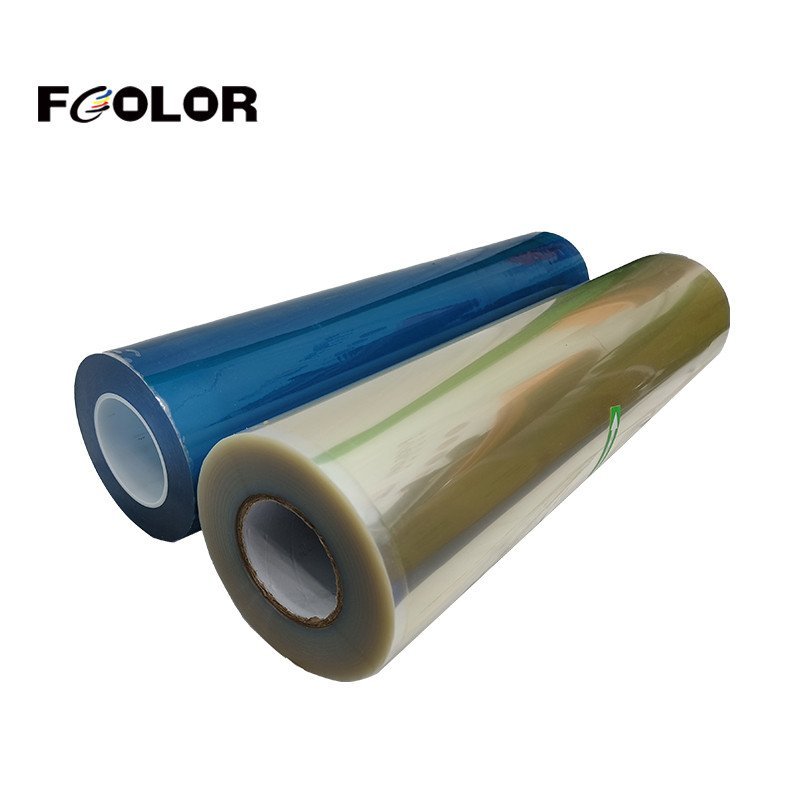
UV DTF crystal labels are a transfer system, not a direct print. You print onto one film, laminate it to a second film, strip away the waste, and then apply the finished graphic to the product. Four steps, two films, one temperature setting.
This article covers how the process actually runs, what lamination temperature the B film needs, and what the A film and B film thickness numbers mean when you are choosing a specification.
One thing worth stating up front, because it causes a lot of confusion: this is not the same process as DTF heat-transfer film. There is no powder, no baking step, and no 160 °C press. Getting that distinction wrong in your head is the fastest way to ruin a roll of crystal label film.
What Is UV DTF Film for Crystal Labels?
UV DTF crystal labels are made with two films that do two different jobs.
| Film | Role | Notes |
|---|---|---|
| A film | Carries the adhesive (glue) layer that the UV printer prints onto | Available in a transparent base and a white base |
| B film | Protective / transfer film, laminated onto the printed A film | The pattern ends up on the B film after waste removal |
The adhesive layer on the A film is formulated for chemical compatibility with UV ink. That is the whole point of the material — the glue has to hold the ink and then hold the product, and those are two different requirements.
The 4 Steps of the UV DTF Film Transfer Process
UV printing
With your artwork ready, the UV printer prints the pattern directly onto the adhesive layer of the A film.
Lamination
A laminator (or the machine's built-in function) presses the B film onto the printed A film. This is the only step in the entire process that requires heat.
Waste removal
Peel away the waste / release film. The pattern transfers completely and stays on the B film.
Transfer application
Lift the pattern off the B film and apply it to the final product.
The fourth step is the one buyers underestimate. Apart from lamination, the entire UV DTF Film transfer is a cold operation. You are not applying heat to the product at any point. That is why crystal labels work on heat-sensitive substrates — and it is the single biggest operational difference between this system and heat-transfer film.
What Lamination Temperature Does UV DTF Film Need?
Typically 90–95 °C.
This is the temperature for the lamination step — pressing B film onto A film — and it is worth being precise about what it does and does not cover:
- It applies to the laminator / film bonding stage only.
- It does not apply to printing. UV ink cures under the printer's UV lamp, not under heat.
- It does not apply to application. Transferring the finished pattern onto the product is cold.
Treat 90–95 °C as a working window rather than a magic number. Your laminator's actual roller or platen temperature, the film batch, and the ambient conditions in your workshop will all move the ideal point slightly. If the waste film tears during removal, temperature is one of the first variables to check — along with pressure and ink curing.
UV DTF Film Thickness: A Film vs B Film
Thickness is where the specification choices actually live, because the A film comes in two very different constructions.
| Layer | Base | Typical thickness | What it is for |
|---|---|---|---|
| A film | Transparent base | ~75 µm | See-through graphics; the substrate shows through behind the print |
| A film | White base (photo-paper base) | ~190 µm | Opaque graphics; the white base blocks whatever is behind the label |
| B film | — | ~80–90 µm | The protective / transfer film the finished pattern ends up on |
The gap between 75 µm and 190 µm is not a small manufacturing tolerance — it is two different products. The white base is roughly two and a half times the thickness of the transparent base, and that difference is why the two are not interchangeable and why pricing differs between them.
Which one do you need?
The decision is about what the graphic has to do, not about which is "better":
- Printing a logo on a glass bottle, a clear phone case, or acrylic where you want the surface to read through the label → the transparent base.
- Printing a colour-blocked graphic on a coloured or dark product, a gift box, or a paper carton where you need the print to hold its own colour → the white base.
Being honest about the limits: the figures above are typical values for our standard product, not a guaranteed gauge for every roll. If thickness is a specification in your own QC or your customer's acceptance criteria, ask for the spec sheet for the exact SKU you are buying rather than assuming the typical range applies.
Getting UV DTF Film Basics Right Before You Scale
Three numbers — 90–95 °C lamination, 75 µm or 190 µm A film, 80–90 µm B film — and one rule: only the lamination step gets heat.
Most crystal label problems we see are not material failures at all. They are one of these basics applied to the wrong stage: heat where there should not be heat, a transparent base where opacity was needed, or a laminator running outside its window. Fix the specification and the temperature first, and a large share of "bad film" complaints disappear before anyone blames the roll.
About FCOLOR UV DTF Film
Fullcolor Technology Limited (FCOLOR) is a professional R&D company and manufacturer of DTF and UV printing solutions, based in Dongguan, China. Our UV DTF crystal label film is built as an A film + B film transfer system, using virgin PET base material from tier-one chemical suppliers — for high transparency, no crystal points and no stretch deformation.
Standard sizes are 30 cm / 60 cm / A4 / A3, with custom widths available. Minimum order is 1 roll, stock specifications ship within 48 hours, and custom specifications take 3–5 days. The film is compatible with neutral UV inks for maximum substrate versatility.
If you are setting up a crystal label line for the first time, tell us what you are printing on and which UV printer you are running — that is usually enough for us to tell you which A film base and which ink to start with.