Sublimation Ink FAQ: Answers from the FCOLOR Support Desk
- Share
- publisher
- FCOLOR
- Issue Time
- Sep 15,2026
Summary
Straight answers to common sublimation ink questions: what materials it bonds to, shelf life, compatible papers and printers, T-shirt transfer time and temperature, why it fails on cotton and black garments, why the ink looks gray in the bottle, export packaging specs, and fixing dull ceramic and metal transfers.
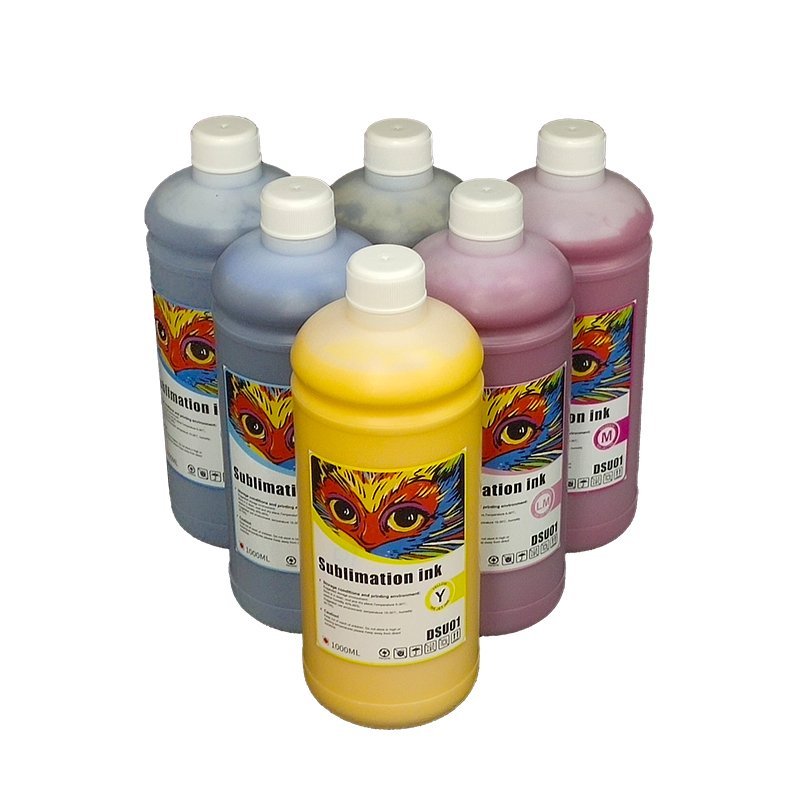
Sublimation ink questions rarely arrive one at a time. A customer buys a bottle, prints a sample, and within a week the support desk hears about shelf life, black T-shirts, dull mugs, and why the ink in the bottle looks gray. This guide collects the sublimation ink questions our technical team answers most often, with the same answers we give on the phone, on the record.
What Is Sublimation Ink and What Materials Does It Work On
Sublimation ink, also called heat transfer ink, works on a simple principle: you print the image onto transfer paper first, then a heat press turns the ink into gas and bonds it into the material. The result is an image that sits inside the substrate rather than on top of it, which is why properly sublimated prints do not crack, peel, or fade in the wash.
The process works on a wide range of materials. In our daily production and customer feedback, the most common applications fall into two groups. For flat textile products: polyester T-shirts, synthetic fabrics, and wooden keychains. For rigid products: mugs, plates, metal plaques, and canvas tote bags. The one shared requirement is a polymer coating or polyester content, because sublimation dye needs something to bond with at the molecular level.
Sublimation Ink Shelf Life, Compatible Papers, and Printer Brands
These three questions come up before any ink reaches a machine, so we answer them together.
- Shelf life: one year from production. Sublimation ink is a disperse dye formulation, and its dispersion stability degrades gradually, so we do not recommend stocking more than you can print within a year.
- Compatible papers: dedicated sublimation paper, both sheet and roll formats, plus standard inkjet paper. Sublimation paper gives the highest transfer rate and sharpest detail; inkjet paper works in a pinch but releases less dye, so colors come out lighter.
- Compatible printers: Epson, Roland, Mimaki, Mutoh, and Ricoh inkjet printers. The majority of installations run on Epson printheads, which is also what most of our sublimation ink is tuned for, including popular desktop models like the L805.
Sublimation Ink Time and Temperature Settings for T-Shirt Transfer
Using our sublimation ink together with our sublimation paper, the starting settings for T-shirt transfer are 20 to 30 seconds at 190 to 210 degrees Celsius. Treat these as reference values, not fixed rules. Fabric weight, weave, and polyester content all shift the sweet spot, so when a customer reports a faded or ghosted print, the first thing we check is whether the press time and temperature were adjusted for that specific fabric. A 10-second difference at the same temperature is often the entire fix.
Can Sublimation Ink Print on Cotton or Black T-Shirts
No, and this is the single most common misunderstanding about the process. It breaks down into two separate limitations.
Black fabric: sublimation works by dye bonding into the fabric under heat. A black garment already carries a heavy dark dye load, and it absorbs the sublimated colors into that darkness, so the printed area stays black no matter what image you press. You can prove this to yourself in ten seconds: put a single drop of sublimation ink on black fabric and watch it disappear into the surface.
Cotton fabric: even on white garments, sublimation ink only delivers good results on non-cotton fabrics or blends with cotton content below 30 percent. Pure cotton white T-shirts accept the transfer poorly because cotton has no polymer to bond with. For pure cotton and black garments, the correct combination is cotton transfer paper with pigment ink. In our own testing, the Qicai A-grade sublimation ink can also handle cotton transfer paper as an alternative, but the standard recommendation remains pigment ink for cotton.
Why Sublimation Ink Turns Gray or Brown in the Bottle
A customer calls in a panic: the black sublimation ink has been sitting for a month and now looks gray or brown. This is not a defect. It is the nature of the ink. Sublimation ink only reveals its true, vivid color after it has been heated and sublimated into a substrate. In the bottle, and even freshly printed on paper, black sublimation ink looks muted, brownish, or outright gray compared with regular dye ink.
So the first response is always the same: print a test and press it. Judge the ink by the transferred result, not by the liquid or the paper output. If the transferred color still comes out light, then we step in with specific technical parameters or an ICC profile matched to the printer and paper combination. Nine times out of ten, the ink was fine and the settings were the problem.
Sublimation Ink Bottle Sizes and Export Packaging
For trade customers planning containers and warehouse space, here are the exact numbers we ship. Standard bottle sizes are 70 ml, 100 ml, 127 ml, 500 ml, and 1000 ml. Export carton specifications are as follows.
| Bottle Size | Units per Carton | Carton Dimensions | Gross Weight |
|---|---|---|---|
| 70 ml | 120 bottles | 46.5 x 37.5 x 25 cm | 14.0 kg |
| 100 ml | 100 bottles | 43.5 x 43.5 x 17.5 cm | 12.7 kg |
| 127 ml | 72 bottles | 46.5 x 37.5 x 25 cm | 13.7 kg |
| 500 ml | 24 bottles | 48 x 32 x 18.5 cm | 13.8 kg |
| 1000 ml | 20 bottles | 40 x 32.5 x 26.5 cm | 22.6 kg |
These figures let freight forwarders calculate pallet plans and container loading without back-and-forth, which is why we keep them in every quotation.
Sublimation Ink on Ceramic and Metal: Fixing Dull Colors
When transfers onto ceramic mugs or metal plates come out flat and lifeless, the ink usually gets blamed first, but two factors decide the outcome. First, rigid substrates need a higher dye load than textiles. For ceramics and metal, we supply the DSU01 series, a high-concentration black plus matching color inks built for hard surfaces. Second, paper matters as much as ink: pairing DSU01 with our European-quality fast-drying sublimation paper gives the ink a clean release and a crisp, saturated result. Customers who switch only the ink see partial improvement; customers who switch both see the difference immediately.
About FCOLOR and Our Sublimation Ink Support
FCOLOR is a printing equipment and consumables manufacturer based in Dongguan, China, with 17 years of production experience behind our sublimation ink, DTF ink, UV ink, and full printer line. Every answer in this guide comes from our technical support desk handling real customer cases, not from a brochure. If you have a sublimation ink question that is not covered here, send us the details, your printer model, paper, substrate, and press settings, and our engineers will respond with specific parameters or a matched ICC profile.