FCOLOR at SIGN ISTANBUL 2026: DTF and UV DTF Printer Lines
- Share
- publisher
- FCOLOR Editorial
- Issue Time
- Oct 8,2026
Summary
A four-day recap of FCOLOR at SIGN ISTANBUL 2026, booth 5D76: the DTF printer series and UV DTF 300 line that drew the most visitors, why Turkish-language booth panels matter for distributors, and the three operability questions buyers asked first - curling after baking, white ink spread and film storage. Covers the UV DTF A film plus B film crystal label process and what print shops in this market need solved: consumable continuity, local support and correct starting parameters.
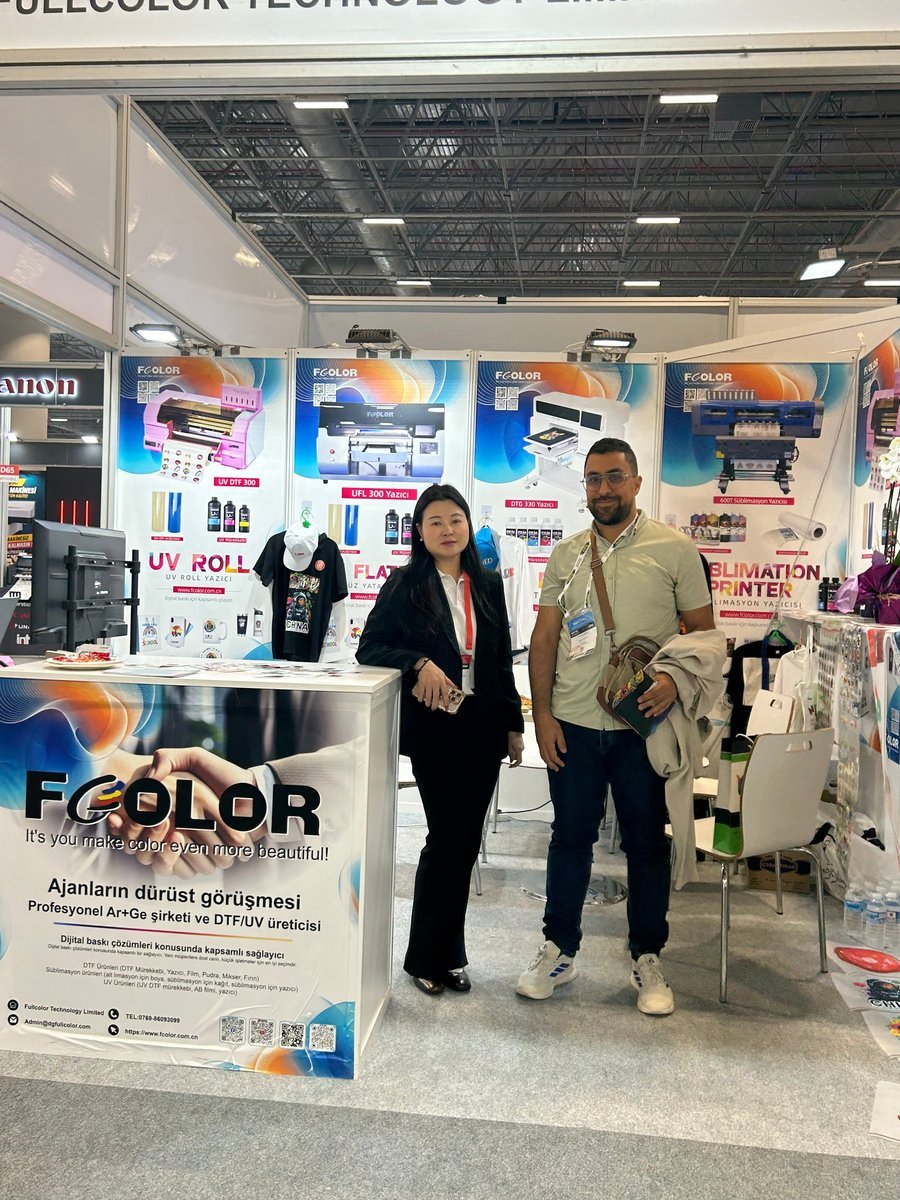
From September 23 to 26, 2026, Fullcolor Technology Limited exhibited at SIGN ISTANBUL EXPO at the Istanbul Expo Center. Over four days, the two product families that visitors came to see most were our DTF printer series and our UV DTF printer series — and the questions around them were consistent enough that they are worth writing down.
This is what we showed, why those two lines pulled the most attention, and what print shops in this market are actually trying to solve.
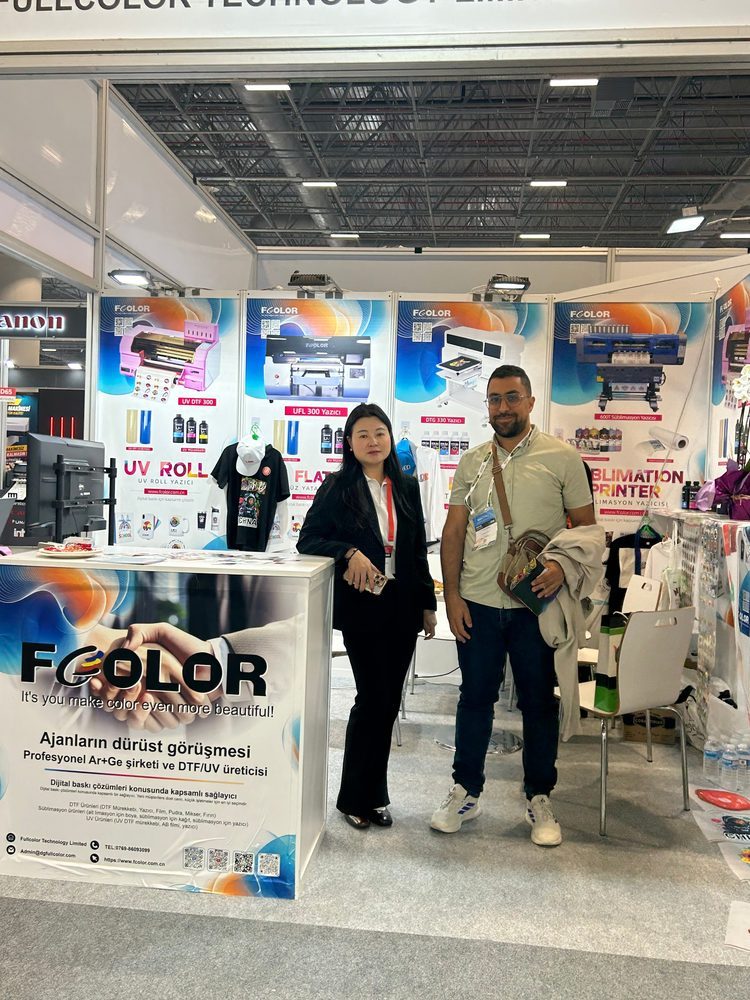
FCOLOR at SIGN ISTANBUL 2026
SIGN ISTANBUL is one of the region's main sign, graphics and digital printing exhibitions, held at the Istanbul Expo Center. The 2026 edition ran September 23–26, and Fullcolor Technology Limited exhibited across all four days.
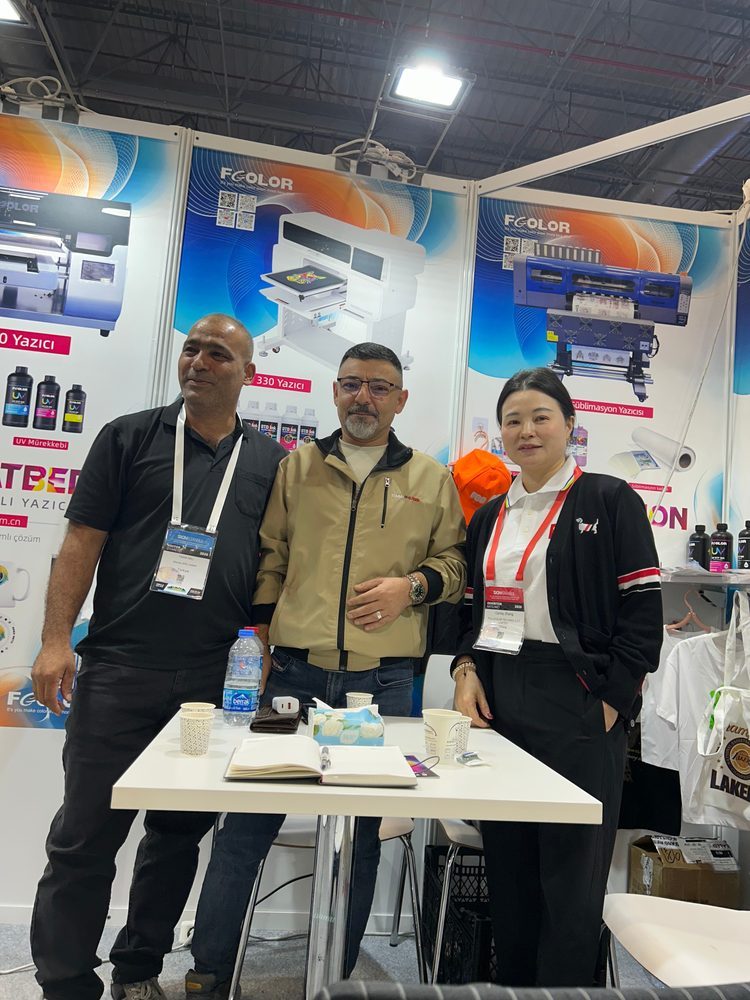
Our booth graphics were prepared in Turkish — positioning Fullcolor Technology Limited as a professional R&D company and a DTF/UV manufacturer, and addressing distributors and agents directly. Product panels carried Turkish naming throughout: UV DTF Yazıcı, UV ROLL Yazıcı, DTG Yazıcı, Sublimasyon Yazıcı, UV Mürekkebi.
That was deliberate. A Turkish-language booth does two things at once: it lets a visitor evaluate the machines without translating in their head, and it signals that the supplier intends to be present in the market rather than ship a container and disappear.
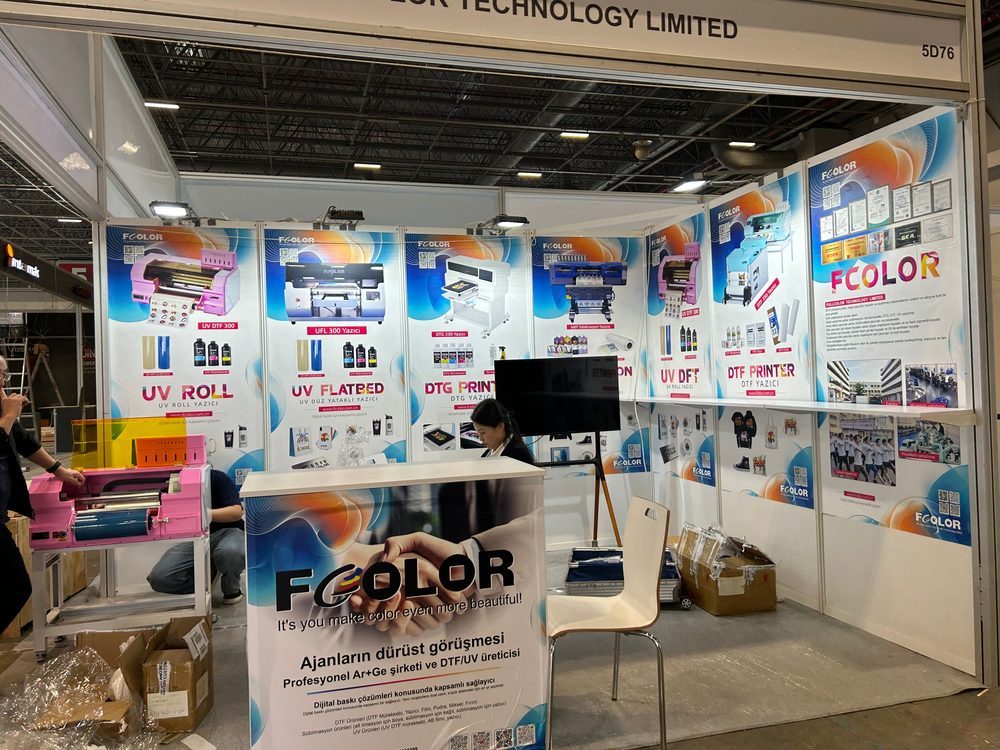
What We Showed at Booth 5D76
The booth was set up as a walk-through of a digital printing line rather than a single-machine display.
| Line | What was on display | Typical buyer |
|---|---|---|
| DTF printer series | DTF Yazıcı with DTF film, pigment ink and hot-melt powder | T-shirt and apparel decoration |
| UV DTF printer series | UV DTF 300 with finished UV DTF crystal label samples | Hard-surface decoration, glass, acrylic, packaging |
| UV flatbed | UFL 300 UV flatbed printer | Signage, rigid substrates, small-format industrial print |
| UV roll | UV ROLL printer for roll-to-roll production | Signage and industrial print shops |
| DTG | DTG 330 printer for direct-to-garment output | Small-batch and sample-oriented garment printing |
| Sublimation | 600 mm sublimation printer with transfer paper | Sportswear, mugs, polyester products |
| Consumables | UV ink, DTF ink and film, hot-melt powder, transfer accessories | Anyone running any of the above |
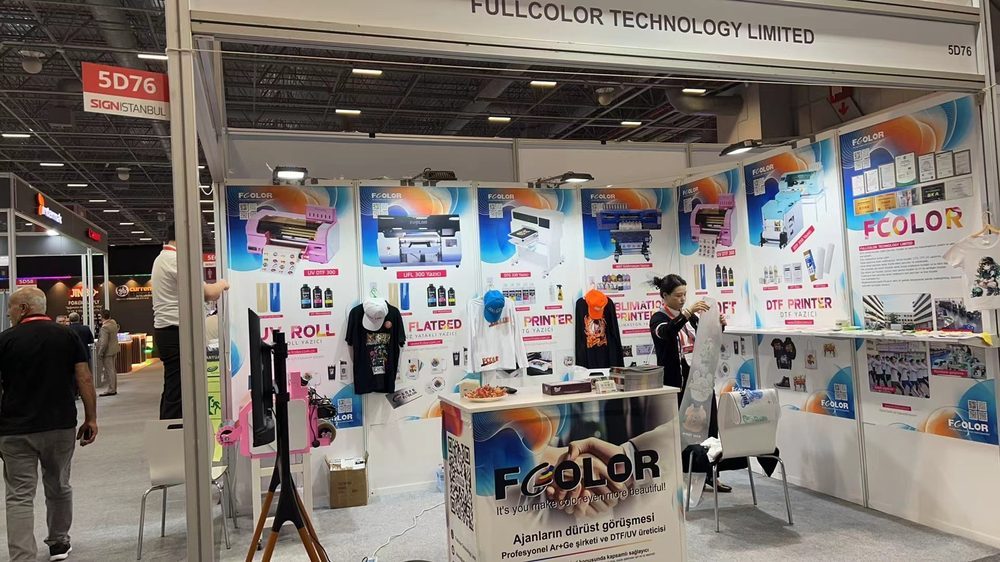
Alongside the machines we displayed finished printed garments — shirts and caps printed on the same equipment — hanging directly on the booth wall next to the panels. In this market that matters more than a specification sheet. Buyers wanted to pick the print up, look at the edge, and feel the surface before they asked about price.
The certification documentation panel was also on display at the booth for visitors who asked about compliance.
Why the DTF Printer Series Got the Most Attention
DTF is the line that garment decorators in this region are moving toward, and the reason is structural: it removes the material constraint of DTG and the setup cost of screen printing. You can print a full-colour photographic design and apply it to cotton, blends and synthetic fabrics without pre-treatment or minimum order quantity.
The questions we spent the most time on were not about print quality at all. They were about operability:
- What happens when a print curls after baking?
- Why does the white ink spread or blur?
- How long can film be stored, and under what conditions?
All three have process answers rather than material answers. Curling after baking is usually temperature or curing time running too high — reduce by 5–10 °C or shorten the bake, one variable at a time. White ink spreading is normally either humidity or a wrong ICC profile, and those need different fixes. Film storage is 12 months under proper conditions — sealed, 15–30 °C, away from sunlight and moisture.
That pattern is worth noting. A buyer evaluating their first DTF line is not short of machine options. What they are short of is a supplier who will tell them what goes wrong and how to fix it.
Why the UV DTF Line Stopped Traffic
The UV DTF 300 drew visitors who were not looking at garment printing at all.
UV DTF is a transfer system rather than a direct print: you print onto the adhesive layer of an A film, laminate it with a B film, strip the waste, and apply the finished graphic to the product. There is no powder, no baking step, and no heat applied to the product during transfer — only the lamination step runs hot, at around 90–95 °C.
That is exactly why it generated interest here. Visitors were printing on acrylic, phone cases, gift boxes, cartons, glass, insulated cups, mugs and notebooks — flat surfaces that cannot go through a heat press. Once the process was explained, the recurring reaction was the same: the constraint they assumed was unavoidable turned out not to be.
The consumable that came up most often in those conversations was the crystal label film itself. We run it as an A film + B film system with a transparent base (~75 µm) for see-through graphics and a white base (~190 µm) for opaque ones, in 30 cm / 60 cm / A4 / A3 sizes.
Beyond DTF: UV Flatbed, UV Roll and 600 mm Sublimation
Not every visitor was shopping for garment decoration, and the wider line mattered to them.
The UFL 300 UV flatbed and UV ROLL printers served visitors whose work is signage and rigid-substrate printing. The 600 mm sublimation printer attracted sportswear and promotional-product shops. And the DTG 330 sat alongside the DTF line for buyers who wanted both routes available in one workshop.
Showing all of it in one booth was intentional. A decorator who starts with one DTF printer and later adds UV DTF or sublimation usually buys that second machine from whoever solved their first problem. A catalogue is not the same thing as a demonstration.
What Print Shops in This Market Need to Solve
Three themes ran through the four days, and none of them are actually about hardware.
Consumable continuity.
A machine is a one-time purchase; film, ink and powder are forever. Buyers wanted to know one thing before signing: can you keep supplying these, at consistent quality, batch after batch. That is a supply-chain question, not a technical one — and the answer has to be demonstrated rather than promised.
Local operational support.
Training, troubleshooting and spare parts matter more in markets far from the factory than any single specification. This is why our booth messaging addressed agents and distributors directly rather than end users only.
Getting the process right the first time.
A large share of complaints about "bad film" or "bad ink" trace back to settings: the wrong lamination temperature, a laminator running outside its window, humidity outside its range, or ink and material mismatched. Documented starting parameters and someone to ask when they do not work is what a new line actually needs.
If you visited the booth at SIGN ISTANBUL and are now setting the line up, send back what you are printing on and which printer you are running. Feedback from an actual production floor is how the parameters in our documentation improve.
About FCOLOR
Fullcolor Technology Limited (FCOLOR) is a professional R&D company and manufacturer of DTF and UV printing solutions, based in Dongguan, China. We produce DTF film, DTF pigment ink, hot-melt powder and UV DTF crystal label film, alongside the DTF, UV DTF, UV flatbed, UV roll, sublimation and DTG printer lines shown at SIGN ISTANBUL.
Our DTF film is available in roll widths of 30 cm, 33 cm, 60 cm and 120 cm and in A3 / A4 sheet formats. UV DTF crystal label film is supplied as an A film + B film system on virgin PET base material, in 30 cm / 60 cm / A4 / A3 with custom widths available. Custom widths, lengths, labels and carton design are available for buyers running their own brand.
Every production batch is tested for coating thickness, peeling performance and colour reproduction before it ships. Minimum order starts at 1 roll for crystal label film, stock specifications ship within 48 hours, and custom specifications take 3–5 days.
If you would like to continue a conversation from SIGN ISTANBUL, or you are evaluating a DTF or UV DTF line for the first time, get in touch at www.fcolor.com and tell us what you are printing on and which machine you run. That is usually enough for us to tell you which configuration makes sense.