DTF White Ink Opacity, Coating and Bleeding Control
- Share
- publisher
- FCOLOR
- Issue Time
- Nov 12,2026
Summary
Four DTF white ink failures and the settings behind each: a translucent underbase from low white laydown and settled titanium dioxide, a density ceiling set by thin single-side PET coating, output that drifts from benchmark after an unlogged driver update, edge bleeding from a total ink limit above 240 percent, and afternoon pooling once workshop humidity passes 65 percent. Includes the evidence to capture first and the choke, PASS and platen values that fix each.
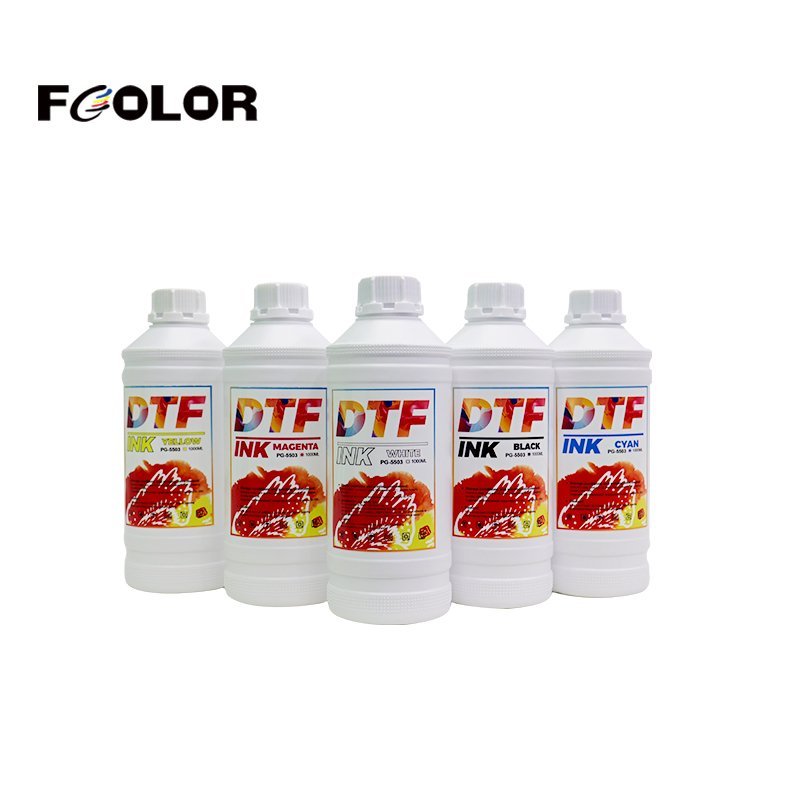
A solid graphic on a black cotton hoodie needs an opaque, dense titanium dioxide white underbase. Digital apparel shops keep failing it from two opposite directions: the underbase goes down too thin, dark fibres show through and the colors go muddy — or the deposit is heavy enough to saturate the PET release coating, and the edges feather, puddle and pool.
Both failures are settings problems far more often than ink problems. This guide covers the four faults, the evidence to capture before touching an ICC curve or scrapping a drum, and the specific values that resolve each one.
DTF White Ink Opacity Problems: The Evidence We Need First
White opacity complaints are the hardest to resolve from a description, because “not white enough” can mean four different things. Capture these five items and the ambiguity disappears.
| # | Evidence | What it separates |
|---|---|---|
| 1 | Underbase and finished garment photos — macro shots under clean 5000 K daylight, showing both the front surface and the edge boundary over dark fabric | Thin deposit versus bleed at the perimeter — two different faults that look similar at arm's length |
| 2 | RIP density and choke screenshots — white ink percentage (70% versus 100%), white choke offset, color channel density limit | Whether the press is being asked for the opacity it is failing to deliver |
| 3 | Golden sample side by side — current print next to an approved earlier sample from the same raster file | Whether anything changed at all, or whether the standard moved |
| 4 | Carriage and platen video — 20 to 30 steady seconds showing ink absorbing into the coating, and whether beading starts immediately behind the sweep | Absorption rate, which no still photo shows |
| 5 | Hygrometer reading — temperature and RH taken at the vacuum platen, not at the office wall | Environment as a variable, before ink chemistry gets blamed |
DTF White Ink Underbase Too Thin: Fabric Showing Through
Symptoms
On black, charcoal or dark navy garments, bright elements — yellow, white, pastel lettering — come out dull, muddy or grey. The garment weave reads through the transfer and white lettering has no clean edge.
| Checkpoint | Observation | Action |
|---|---|---|
| 1. Software laydown | White channel percentage in the RIP | Raise white density to 80–95% |
| 2. Pigment suspension | White sub-tank and supply line condition | Run the circulation loop before printing |
| 3. Ink age and sediment | Sediment layer at the bottom of the bulk tank | Discard hard-caked ink, charge a fresh batch |
| 4. Film absorption base | Wet-ink threshold of the coating | Move to dual-matte high-load PET |
Root cause
- White generation set too low — 50–60% produces a layer that cannot block light reflected back off dark synthetic or cotton fibre
- Titanium dioxide settling — rutile TiO2 has a specific gravity around 4.2 g/cm³. Without active circulation the particles drop out of suspension within hours, and the siphon draws low-density carrier
- Insufficient coating capacity — economy single-side PET carries roughly 2–3 micron of coating, which cannot hold heavy white without overflowing. Operators respond by turning white volume down, and the film quietly sets the ceiling
Remediation
- Calibrate white output in the RIP. In the media profile (CADlink Digital Factory, Maintop or Photoprint), raise the white laydown curve to 80–95% under colored elements and 100% on pure white vector lettering.
- Set the white choke deliberately. A choke of 1–2 pixels (0.1–0.2 mm) keeps white from haloing past colored borders while preserving full perimeter coverage. Too much choke pulls white back and the edge looks under-filled; none at all and you get the halo.
- Restore suspension before blaming the drum. Confirm the timed white circulation loop is actually running during production, not only on the standby schedule. If white sat in the lines overnight, purge 20–30 ml from the damper manifold to waste so agitated ink reaches the chambers.
- Then look at the film. FCOLOR double-sided matte PET uses a multi-layer micro-porous silica coating with roughly 35% more ink absorption capacity, which is what allows a heavy white deposit without edge beading.
DTF White Ink Density and Film Coating Compatibility
The frustrating part of thin white is that operators often solve it backwards. They raise the white percentage, the film cannot absorb it, edges bead, and they pull the percentage back down — arriving at a stable setting that is permanently 20% too light. The film coating is a hard ceiling, and no curve overrides it.
| Film type | Typical coating | What it supports |
|---|---|---|
| Economy single-side PET | Thin, roughly 2–3 micron | Moderate white at reduced density; heavy deposits bead at the edge |
| Standard double-side matte | Multi-layer micro-porous silica | Full white laydown at 100% with clean release |
| High-load dual matte | Thicker porous layer, around 35% more capacity | Heavy white for dark garments, high-saturation color on top, no pooling |
Practical test before you buy the next pallet: print a 100% white patch at the density you actually need, then look at the boundary under a loupe. A clean edge means the coating is holding. A dark rim or a visible bead means you are at the ceiling and the answer is a higher-load film, not a lower setting.
DTF White Ink Output That Drifts From Your Benchmark
Symptoms
A file that printed with rich saturation last week now shows mismatched color, shifted mid-tones or harsh gradient banding — same artwork, same ink, apparently same settings.
Root cause
- Unlogged software and firmware updates — a driver update changes default halftoning, resolution (720×2400 dropping to 720×1200) or PASS mode, with no recalibration
- Corrupt or mismatched ICC — falling back to a generic profile, or loading a glossy film profile while running matte media
- Hardware calibration drift — printhead voltage trim or bidirectional offset moving after maintenance or a head strike
Remediation
- Verify the file, not just the print. Confirm the raster imported into the RIP matches the master in resolution, color workspace and layer transparency, and that no automatic RGB-to-CMYK conversion filter ran on export.
- Reload and lock the factory profile. Re-import the certified FCOLOR ICC matching your exact configuration — dual i3200-A1, 8-PASS, 720×2400 dpi is a different profile from a single-head machine. Then lock it, so a shift operator cannot quietly overwrite it at 2 a.m.
- Re-establish the baseline with numbers. Print a 100% CMYK step wedge and compare L*a*b* readings against your recorded baseline with a spectrophotometer. That tells you whether the drift is optical, mechanical or chemical — a judgement the eye cannot make reliably.
DTF White Ink Bleeding at Color Boundaries
Symptoms
At boundaries — most visibly where saturated black or navy meets white underbase — ink creeps outward across the film. Margins go fuzzy, fine lettering blurs, and detailed areas turn mottled.
| Variable | Threshold violation | Remedial setting |
|---|---|---|
| Total ink limit | Combined CMYK plus white above 240% | Cut dark areas by 20–40% |
| PASS count | 4-PASS high speed | Raise to 6-PASS or 8-PASS |
| Platen temperature | Front heater off, platen at ambient | Set front heater to 38–42 °C |
| Coating grade | Single-side economy film | Move to multi-porous high-load film |
Root cause
- Excessive total ink laydown — firing 100% CMYK onto 100% white pushes coverage past 240–260%, and the liquid phase saturates the silica release layer faster than the front heater can flash off co-solvents
- High-speed low-PASS screening — 4-PASS bidirectional lays down too much liquid per unit of time, overwhelming absorption before the droplets immobilise
Remediation
- Cut liquid volume, not density. Lower the total ink limit across dark recipes by 20–40%. Because FCOLOR nano-pigment inks carry high optical density, a 25% reduction in liquid volume holds visual saturation while the boundary bleeding disappears.
- Slow the laydown. Move high-saturation work from 4-PASS to 6-PASS or 8-PASS, so droplet volume is spread across more sweeps and the micro-porous coating can absorb solvent between passes.
- Warm the platen. Set the front heater to 38–42 °C. Mild contact heat lowers surface tension slightly and speeds carrier evaporation, which sets the drop perimeter before the white goes down.
DTF White Ink Pooling When Nothing Has Changed
Symptoms
Jobs that ran clean in the morning puddle, crawl and pool in the afternoon — identical file, identical ink, identical RIP settings.
Root cause
- Workshop humidity above the safe ceiling — above 65–70% RH the water-soluble release coating absorbs moisture straight from the air, and its remaining liquid capacity can fall by up to 50%
- Damp film rolls — an unsealed roll left on the feed rack picks up ambient vapour and loses capillary suction
Remediation
- Hold the room, not the press. Keep production space within 20–25 °C and 45–55% RH, with dehumidifiers running continuously. A DTF printer in an unconditioned warehouse, or next to an open pre-treatment wash station, will always be the last machine to stabilise.
- Seal film between shifts. Unseal rolls only immediately before mounting. At the end of every shift, dismount the remainder, seal it in the original foil barrier bag with desiccant and store it in a climate-controlled cabinet.
- Buy time with ink-cut. When weather moves faster than the HVAC, apply a temporary 15–20% software ink-cut across all channels to stop pooling on the web. It is a stopgap — the room still has to be fixed.
DTF White Ink Defect Summary: Four Faults, Four Fixes
| Symptom | Verify | Probable cause | Factory solution |
|---|---|---|---|
| Underbase not white | RIP white slider; sub-tank circulation | White laydown too low; TiO2 settled; low-load film | White density to 80–95%; agitate; high-load PET |
| Differs from benchmark | Raster resolution; active ICC profile | Profile replaced; halftoning changed; step drift | Reload and lock factory ICC; recalibrate bidirectional stepping |
| Edge bleeding | Combined ink limits; PASS count | Ink limit above 240%; rapid laydown; cold platen | Cut dark ink 20–40%; 6 or 8 PASS; pre-heat platen to 40 °C |
| Pooling and running | Room hygrometer; film roll age | Humidity above 65% RH; coating dampened | Dehumidify to 45–55%; store in foil bags; adjust ink-cut |
The one habit that prevents most of these: write the values down. White percentage, choke, total ink limit, PASS mode, platen temperature, room RH. When a print fails next month, a recorded baseline turns a two-day argument into a five-minute comparison.
About FCOLOR DTF White Ink
Dongguan Fcolor Digital Technology Co., Ltd. researches, synthesises and precision-coats digital printing consumables at its plant in Dongguan, on certified cleanroom synthesis lines producing:
- DTF inks — ultra-fine pigment dispersion with high TiO2 opacity, stretch elasticity and anti-settling formulation
- DTF transfer media — single-side and double-side matte PET engineered for high ink loading, crisp edge release and anti-static stability
- Digital ink suite — textile pigment, dye sublimation, UV curable inks and specialty functional primers
White opacity complaints are usually solvable on the phone once the press settings and a hydrometer reading are on the table. Send those two and a photo of the boundary under daylight, and we will tell you which single variable we would change first.