DTF Transfer Stretch Cracking and Oiling: Causes and Fixes
- Share
- publisher
- FCOLOR
- Issue Time
- Nov 16,2026
Summary
Three DTF transfer failures and the cure-side cause behind each: stretch cracking from powder that never coalesced, thin white layers and rigid EVA grades; oiling in storage when glycol humectants stay trapped under the melted powder; and greasy haloes on garments a day or two after pressing. Includes the evidence pack to send first, the surface temperatures to verify with a pyrometer, and the pre-press and secondary seal routine that stops edge oiling.
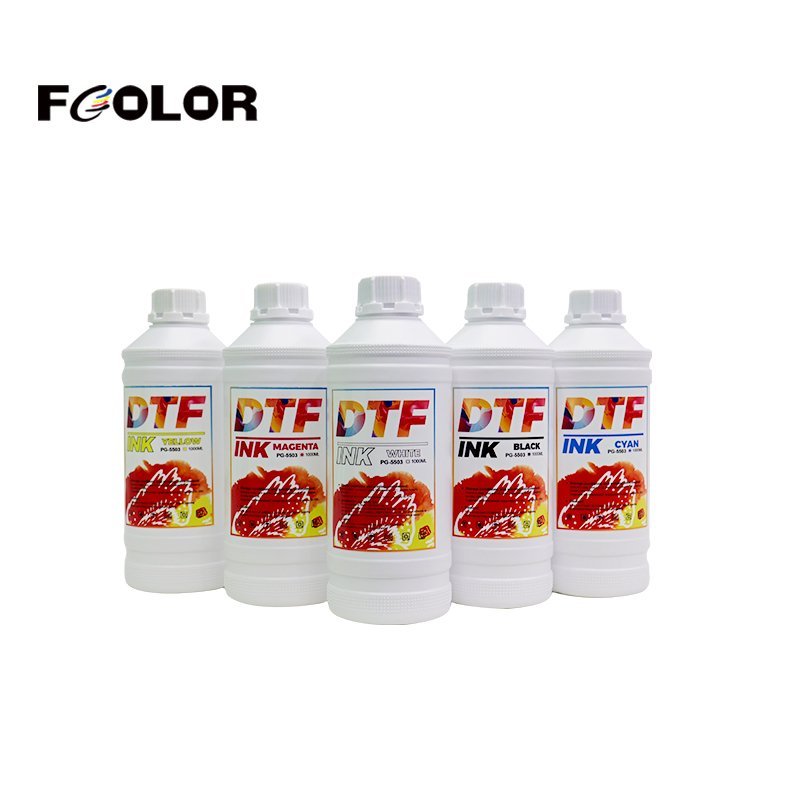
A DTF transfer is supposed to survive wear, lateral stretch and industrial laundering without splitting or sweating grease. Two defects break that promise after the print has already passed inspection: stretch cracking, where the film splits under moderate tension, and transfer oiling, where greasy droplets bleed out of the sheet during storage or onto the garment after pressing.
Neither is usually a bad batch. One is a melting problem, the other is a chemistry problem, and both are visible in evidence you can collect before shipping anything back.
DTF Transfer Cracking and Oiling: The Evidence Pack to Send First
These two defects get argued about more than most, because the print left the shop looking correct. The evidence below lets an engineer separate under-curing from incompatible powder from ambient humidity, without guessing at the customer's description.
| # | Evidence | What it decides |
|---|---|---|
| 1 | Elongation video and macro shots — 10 to 15 steady seconds of the garment stretched laterally until the crack starts, plus macro photos of the fractured cross-section under direct light | Whether failure is cohesive (ink tears) or adhesive (layer separates from fabric) |
| 2 | Cured powder-side texture — macro photo of the powder face before pressing | Fully melted film shows a smooth orange-peel sheen; a dull sandy surface means the powder never coalesced |
| 3 | Oiling documentation — photos of droplets or a shiny film on stored sheets, plus a wipe test with absorbent tissue | Whether the residue is surface condensation or exudate from inside the layer |
| 4 | Curing and press parameters — set temperature, true surface reading, dwell time in seconds, press temperature, time and pressure | Controller setpoint versus what the film actually saw — these diverge more often than anyone expects |
| 5 | Climate telemetry — RH and temperature in both the print room and the transfer storage area | Glycol migration is humidity-driven, and the warehouse is usually the culprit |
DTF Transfer Stretch Cracking: Why the Print Splits Instead of Flexing
Symptoms
Stretch a decorated cotton, polyester or blend garment horizontally and the graphic does not flex. Fine micro-fissures or jagged lateral splits open across dense white areas, exposing fabric underneath, and they do not close when tension is released.
| Inspection stage | Defect state | Engineering remedy |
|---|---|---|
| 1. Adhesive melt layer | Gritty, granular powder still visible | Raise oven temperature or dwell time |
| 2. White and color layer | Flaky, paper-thin white deposit | Increase white density in the RIP |
| 3. Polymer grade | Standard coarse, rigid EVA or TPU | Switch to high-elasticity TPU |
| 4. Thermal crosslinking | Incomplete cure bond | Verify 120–130 °C at the film surface |
Root cause
- Incomplete adhesive melting — if the tunnel never reaches the true melting point of the TPU powder, particles stay granular instead of coalescing into a continuous flexible membrane. Tensile strain then acts directly on a brittle ink layer with no elastic backing
- Under-thickness white underbase — below roughly 60–70% white laydown the pigment layer has no structural cohesion, and thin films tear because they have no internal tensile resilience to distribute stress
- Rigid or incompatible powder chemistry — low-cost powders built on rigid EVA or low-grade vinyl blends recover poorly, often under 150% elongation, and crack under modest strain on spandex or rib-knit cotton
Remediation
- Measure the film, not the display. Read the true surface temperature inside the chamber with an infrared pyrometer or a trailing thermocouple wire. Controller readouts describe the air, and air is not what melts powder.
- Set the cure to the machine type. Drawer ovens need 120–130 °C at the film surface; high-velocity conveyor tunnels run 130–140 °C for 90–120 seconds. Where cracking is already appearing, dwell time is usually the missing variable — the standard baseline of 60–90 seconds gets a job through, but a 120–180 second dwell is what fully coalesces the layer on a thick white deposit.
- Judge the result by texture, not by time. A correctly cured powder layer turns into a continuous, uniform, semi-gloss orange-peel surface with no visible white grains. If you can still see powder, the clock is not the answer — the temperature is.
- Build the ink layer up. Raise white density to 80–95% so the cured cross-section reaches roughly 15–25 micron. At that thickness the ink film acts as an elastomeric cushion and flexes with the fibres instead of resisting them.
- Match the powder to the garment. On stretch fabrics, standardise on high-elastic TPU micro-powder in 80–170 or 120–200 mesh. Aliphatic polyurethane grades recover beyond 250% elongation without structural fracture, which is the difference between a print that stretches and a print that splits.
DTF Powder Grade and the Limits of Soft Hand-Feel
There is a real trade-off here that sales conversations tend to skip. Finer mesh gives a softer hand-feel and better detail, but a thin adhesive layer has less material to absorb strain. Coarser mesh bonds harder and stretches further, at the cost of a heavier feel on the garment.
| Powder route | Behaviour under stretch | Where it fits |
|---|---|---|
| Rigid EVA or low-grade vinyl blend | Low recovery, cracks early on elastic fabric | Low-cost work on stable woven goods only |
| Standard TPU, coarse mesh | Strong bond, moderate recovery, heavier hand | Workwear, bags, high-wear graphics |
| High-elastic TPU, 80–170 mesh | Recovery beyond 250%, soft hand | Stretch apparel, sportswear, retail-grade tees |
If a customer is buying on price alone, this is the specification where the saving shows up first — and where it comes back as a cracking complaint three weeks later.
DTF Transfer Oiling in Storage: Where the Glycol Comes From
Symptoms
Cured rolls or stacked sheets develop a sticky, greasy film over the printed area after 3 to 14 days on the rack. In bad cases the liquid transfers to the back of the adjacent sheet, causing feed roller slip or staining the packaging.
| Factor | Mechanism | Countermeasure |
|---|---|---|
| Incomplete bake-out | Humectant glycols trapped under the powder | Extend bake time; extract vapours |
| Shaker versus oven curing | Tunnel air saturated with glycol vapour | Increase exhaust extraction |
| Packaging method | Open storage in a humid warehouse | Foil barrier bags with desiccant |
| Shelf-life window | Gradual moisture-driven phase separation | Target a 1–3 month inventory cycle |
Root cause
Water-based DTF ink carries high-boiling humectants — glycerin, propylene glycol, diethylene glycol — precisely so the nozzles stay wet. They are supposed to leave during curing. When they do not, they come back later as oil.
- Incomplete evaporation — too brief a bake or weak exhaust leaves glycols trapped beneath the melted powder. Over days they migrate to the surface through capillary phase separation
- Exhaust deficiency — on conveyor shaker dryers the vapour has to be actively extracted. An under-powered or clogged blower saturates the chamber, and glycol condenses back onto the cooling web
- Unsealed humid storage — glycols are strongly hygroscopic. Above 65% RH the film absorbs ambient moisture, which accelerates migration and liquefaction
Remediation
- Give the volatiles a way out. Raise tunnel temperature by 5–8 °C or cut conveyor speed by 10–15%, so high-boiling humectants flash off before the powder caps the ink layer.
- Service the exhaust weekly. Clean the ducting and blower, and confirm continuous negative pressure so solvent leaves the building instead of condensing inside the tunnel. A clogged exhaust is the single most common cause of a sudden oiling complaint on a line that ran clean for months.
- Cool before you roll. Let transfers come down to room temperature in a conditioned space at 45–55% RH before stacking or winding. Winding warm traps vapour against the next layer.
- Pack for moisture, not for shipping. Heavy polyethylene or laminated foil barrier bags, 50 g silica desiccant per carton, heat-sealed or airtight zipped.
- Run FIFO. Apply transfers within 1 to 3 months of printing. Stock rotation is not an administrative habit — it is a shelf-life control.
DTF Transfer Oiling on the Garment: Pre-Press and Secondary Seal
Symptoms
The transfer looks dry at peel. Within 24 to 48 hours a dark greasy ring appears on the fabric around the design edge, or the print surface feels slippery and collects dust.
Root cause
- Fabric moisture and sizing — raw cotton and fleece carry 5–10% moisture by weight along with finishing oils and silicone softeners. At 150–160 °C that moisture flashes to steam and drives trapped ink glycols outward into the surrounding fibres
- No post-peel venting — peeling immediately seals the top boundary. Vapour that could not escape sideways during the press settles into the porous weave at the perimeter
Remediation
- Pre-press the blank, every time. Five seconds at 150–160 °C on the empty garment before the film goes down. This drives out moisture, flattens the pile and burns off finishing oils — three problems in one step, and the one step operators skip when the line is busy.
- Seal with a second press. After peeling — hot, warm or cold per the film spec — cover the graphic with matte silicone parchment or a PTFE sheet and press again for 5 to 8 seconds at 150–160 °C under medium-firm pressure of 3–4 bar. This vents microscopic vapour pockets, pushes molten TPU deeper into the weave and locks the ink layer.
- Re-bake stubborn stock. If a whole batch of pre-printed film oils on fabric, run the sheets through an open-tray oven at 110 °C for 60 seconds before pressing.
DTF Transfer Defect Summary: Three Faults, Three Fixes
| Problem | Checkpoint | Root cause | Factory action |
|---|---|---|---|
| Cracking on garment | Powder-side texture; white layer thickness | Under-cured granular powder; thin ink; brittle EVA | Surface to 120–130 °C; white density 80–95%; high-elastic TPU |
| Oiling in storage | Room humidity; exhaust velocity | Glycols unbaked; saturated tunnel exhaust; unsealed storage | Longer dwell; clear ducting; foil bags with desiccant; 1–3 month turnover |
| Oiling on fabric edge | Pre-press routine; garment moisture | Fabric steam drove glycol outward; no secondary seal | 5 s pre-press; 5–8 s parchment press; oven-dry stubborn stock |
Both defects share one root: something that should have left the film during curing stayed in it, or something that should have stayed in the ink left it during pressing. Temperature, dwell and exhaust control both directions.
About FCOLOR DTF Ink and Powder
Dongguan Fcolor Digital Technology Co., Ltd. formulates and converts digital textile printing consumables at its plant in Dongguan, with matched chemistry across the three components that decide whether a transfer cracks or sweats:
- DTF inks — high-elastic, anti-settling pigment with ultra-pure rutile titanium dioxide for opacity and resistance to premature cracking
- High-elastic TPU powder — low-viscosity, high-rebound polyurethane micro-powder in 80–170 mesh, built for soft hand-feel, no adhesive strike-through and 60 °C wash fastness
- Release PET films — single-side and dual-side matte with temperature-resistant backcoating, anti-static and resistant to powder sticking
Because all three come from one formulation line, the powder is matched to the ink's humectant load rather than sold alongside it. That is the part that matters when a line starts oiling and nobody changed anything.