DTF Ink Problems and Solutions: A Field Troubleshooting Guide
- Share
- publisher
- FCOLOR
- Issue Time
- Sep 3,2026
Summary
Real answers to common DTF ink problems from the FCOLOR technical support desk: measured ink and powder consumption per square meter, why white DTF ink settles, head clog recovery, correct printer and heat press settings, and color fixes with film choice and ICC profiles.
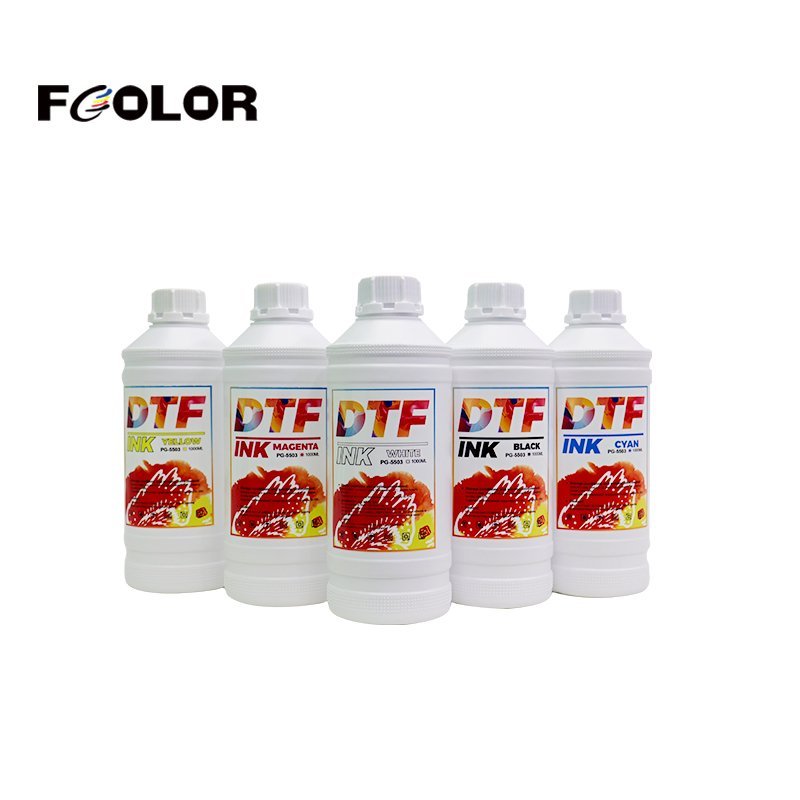
DTF Ink Knowledge Base
Every DTF ink question below comes straight from our technical support desk. These are the problems shop operators actually call about, answered with the numbers we use on our own production floor.
How Much DTF Ink and Powder Does One Square Meter Really Consume
This is the first question most buyers ask, and the honest answer is: it depends on coverage. So instead of guessing, we ran a measured test on one of our own DTF printers and recorded the results.
Test conditions: normal production artwork, print coloration rate around 70 percent, ten A4-size images printed in one batch covering a total of 7.7 square meters of film. The measured consumption broke down as follows:
- CMYK DTF ink used: about 143 grams, or roughly 18.5 grams per square meter
- White DTF ink used: about 314.2 grams, or roughly 40.7 grams per square meter
- Hot-melt powder used: 320 grams, or roughly 41.5 grams per square meter
Notice that white ink burns through more than double the CMYK volume. That is normal, because white lays down a full underbase layer beneath every colored pixel. If you are costing out jobs, budget powder at about the same rate as white ink, and remember that denser artwork pushes all three numbers up.
Why White DTF Ink Settles and How to Stop It Clogging Your Head
White DTF ink is not magic. Its main pigment is titanium dioxide, and titanium dioxide is heavy, which means it settles. That is true of every white ink from every manufacturer, no exceptions worth arguing about. What separates a smooth-running shop from a clogged one is how the ink is handled.
Two rules from our support team. First, do not fill the white ink tank to the brim if your daily white volume is small. Fill what you will use, and refill when it runs low. Ink sitting unused in a tank is ink that is quietly settling. Second, never leave white DTF ink standing completely still for months. In our experience, white ink left static for around three months will crystallize. Inside three months, with normal circulation and printing, you are fine.
If a customer asks whether our white is white enough, we point them to our PG2003 high-density white DTF ink. High opacity, strong coverage, and it holds up on dark garments without a double pass.
DTF Ink vs Sublimation Ink: The Differences That Matter
Both DTF ink and sublimation ink transfer onto fabric using heat, which is why people mix them up. Past that similarity, they work completely differently.
- White ink: DTF ink needs a white layer for opacity. Sublimation never uses white.
- Print media: DTF ink prints onto PET film. Sublimation ink prints onto sublimation paper.
- Process steps: After printing, DTF requires powder application and curing before transfer. Sublimation prints and presses directly.
- Fabric range: DTF ink transfers to virtually any fabric, cotton included. Sublimation only bonds to polyester or poly-blends, and printing on pure cotton needs a completely different ink and paper workflow plus cut-out pattern transfer.
When a customer calls saying their transfers will not stick to cotton shirts, the first question we ask is which ink they loaded. Nine times out of ten, sublimation ink went into a DTF workflow.
DTF Ink Printing Parameters: Ink Volume, Oven and Heat Press Settings
Correct parameters eliminate most quality complaints before they start. These are the values we ship to customers and run ourselves.
- Ink volume: On an L1800-class printer, set white DTF ink to 90 to 100 percent and CMYK to 13 to 15 percent. Different machine drivers read these percentages differently, so treat them as a starting point, not gospel.
- Oven curing: 105 to 110 degrees Celsius for about 3 minutes.
- Powder shaker: 105 to 145 degrees Celsius, scaled to belt speed. The faster the belt, the higher the temperature setting.
- Heat press transfer: 160 to 165 degrees Celsius for 10 to 15 seconds.
Common transfer defects such as film that will not peel cleanly, designs that scrape off, or prints that crack after washing usually trace back to one thing: the ink and powder were not fully cured before pressing. If you see those symptoms, adjust curing temperature and time first, and check that the powder shaker is actually reaching its set temperature.
Fixing DTF Ink Color Problems: Dull Prints and ICC Profiles
When a customer says the printed colors are not vivid enough, ask which film they are using before touching a single setting. Matte film mutes color by nature. Switching the same artwork and the same DTF ink to a glossy film visibly brightens the transferred result. Ask for a photo of the film to confirm.
When the printed color differs badly from the on-screen design, the fix depends on the machine. For desktop printers converted from L1800, L1390, or L805 platforms, we send the matching ICC profile directly and that usually resolves it. For large-format DTF printers, the mainboard and print head combination determines the ICC profile, so those cases go through our engineering team rather than a one-size-fits-all file. That is not us being difficult. A wrong ICC on a wide-format machine wastes far more ink than it saves.
Recovering a Clogged Head and Daily DTF Ink Maintenance
When a customer calls with a clogged head, the last thing they want is a debate about whose fault it is. Our approach: solve the problem first, then teach prevention.
Act fast. A head that just started clogging can usually be recovered by removing it and soaking in a strong cleaning solution. A head left clogged for weeks will often block permanently, and we tell customers that honestly rather than promising miracles. After recovery, the prevention routine is simple: keep white ink circulating, do not overfill tanks for low-volume weeks, and never let the printer sit idle for months without maintenance cycles.
About FCOLOR and Our DTF Ink Support
FCOLOR manufactures DTF printers, DTF ink, film, and powder at our factory in Dongguan, China, and ships to print shops worldwide. Every batch of DTF ink we sell is backed by the same technical support desk that produced the answers above, including measured consumption data, ICC profiles for common desktop platforms, and engineering support for wide-format setups. If you are troubleshooting a DTF ink problem that is not on this list, contact our team and we will work through it with you.